Google's May 2026 core update finished rolling out on June 2, after nearly 12 days in motion, and practitioners who track these things closely are calling it the heaviest core update of the year. Glenn Gabe called the impact "big" and said it spanned "across verticals and countries." Lily Ray reported sites seeing sudden surges …


Google’s May 2026 core update finished rolling out on June 2, after nearly 12 days in motion, and practitioners who track these things closely are calling it the heaviest core update of the year. Glenn Gabe called the impact “big” and said it spanned “across verticals and countries.” Lily Ray reported sites seeing sudden surges over a single weekend. For site owners watching their traffic charts jump around, the instinct is almost always the same: something broke, and someone needs to fix it.
That instinct is usually wrong. Google describes core updates as routine recalibrations of quality signals, not penalties aimed at specific sites. The May update ran concurrently with Google’s I/O announcements, including the rollout of Gemini 3.5 Flash as the model now powering AI Search. The timing wasn’t a coincidence: the update wasn’t just re-ranking pages, it was adjusting to a search experience that increasingly runs through an AI layer before a human ever sees a blue link.
Volatility Isn’t the Verdict
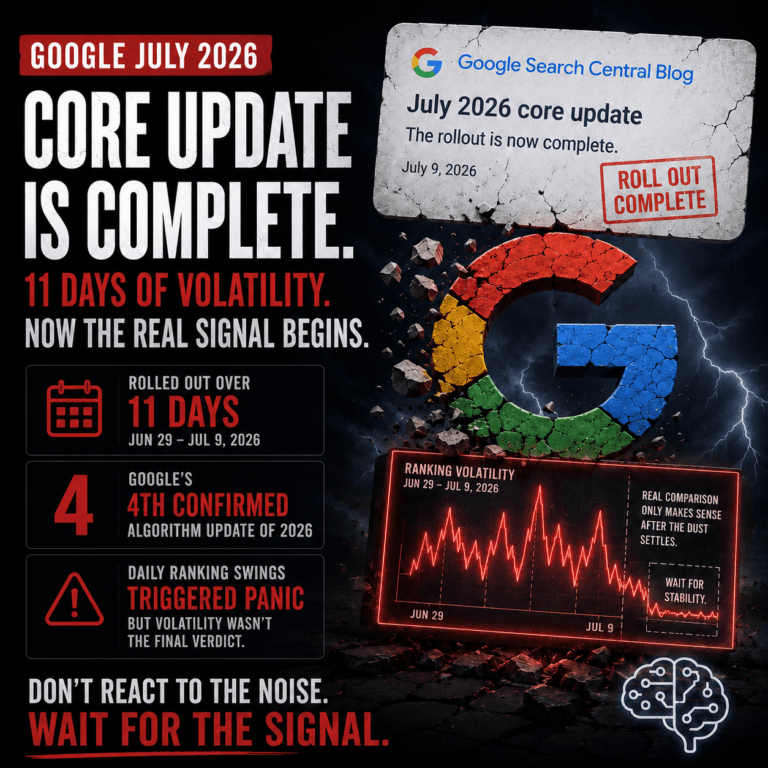
Ranking data during the rollout showed movement at multiple points, not just at launch and completion. A site that dropped on May 24 may be responding to something entirely different than one that moved on June 2. That’s why Google’s own guidance says to wait a full week after completion before drawing conclusions from Search Console, comparing that week against the week before the rollout began. For this update, that clean window doesn’t open until around June 9.
Sites that reacted within days of the rollout, rewriting content, disavowing links, restructuring navigation, were mostly reacting to noise, not signal.
What Actually Moved the Needle
The pattern across this update and the March update before it points the same direction: Google is devaluing content built to scale traffic without adding real value, and rewarding topical authority instead. A handful of deeply researched pieces in a specific niche are outperforming broad coverage of every high-volume keyword in an industry. That’s consistent with what we’ve seen across client sites at Obsidian Pinnacle: depth and clarity on a narrow set of topics is beating volume, and it has been for several updates running now.
The Practical Move
Don’t react to single-day ranking swings, and don’t treat a core update like a penalty notice. Wait for the clean comparison window, then look at patterns across pages, queries, and search types rather than one dramatic screenshot. If your rankings did shift, the fix is rarely “make more content.” It’s making the content you have clearer, more specific, and easier for both readers and AI systems to trust.
Not sure whether your last ranking swing was signal or noise? Book a consultation and we’ll walk through your Search Console data together.
Related reading: Why Traditional SEO is Dying (And What Replaces It) · Your Site Might Be Ranking on Google and Invisible to AI. Here’s Why.
Sources: Search Engine Journal (June 2026)
Kevin