Here's a scenario playing out across thousands of websites right now: a business ranks on page one of Google, their Search Console looks healthy, and yet their brand never appears in AI-generated answers. No citations. No mentions. Nothing. It's not a content problem. It's a retrieval problem; and it's one most SEO audits aren't designed …


Here’s a scenario playing out across thousands of websites right now: a business ranks on page one of Google, their Search Console looks healthy, and yet their brand never appears in AI-generated answers. No citations. No mentions. Nothing.
It’s not a content problem. It’s a retrieval problem; and it’s one most SEO audits aren’t designed to catch.
AI Crawlers Don’t Behave Like Googlebot
Google has spent years getting better at rendering JavaScript. Its crawler can execute JS, wait for content to load, and index what users actually see. AI retrieval systems largely cannot.
Most AI crawlers parse raw HTML only. If your site relies on a JavaScript framework like React or Next.js to render core content after the initial page load, that content may be invisible to AI systems entirely; even if Google has indexed it and it’s ranking well.
The result: your rankings are real, but your AI visibility is zero. And with AI Mode, AI Overviews, and LLM-based search tools now sitting between users and traditional results, that gap has real commercial consequences.
AI Retrieval Is a Separate Visibility Layer
New analysis published in late May 2026 made the point clearly: retrieval should be treated as a separate visibility layer; it’s not a ranking factor, and it doesn’t replace SEO, but it increasingly determines whether content can be surfaced, summarised, or cited once AI systems sit between users and traditional search results.
This means technical SEO now has an additional dimension. Beyond crawlability and indexation, sites need to be structured so that AI systems can reliably extract, embed, and retrieve content. That means server-side rendering or static HTML for core content, clean semantic structure, and schema that helps AI systems understand context without needing to execute code.
Most GEO Measurement Is Also Broken
The measurement problem compounds this. Most teams tracking AI visibility are monitoring individual prompts; checking whether their brand appears in specific AI answers. That approach tracks volatility rather than sustained visibility or influence.
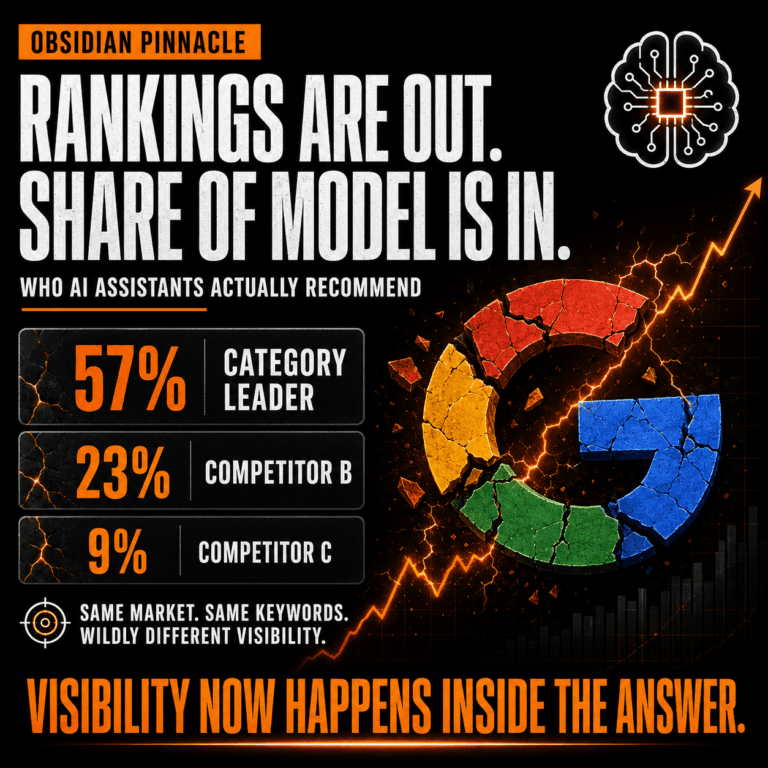
The more defensible framework tracks topic-level presence: citation frequency across a set of core topics, share of model voice, content retrieval success rate, and entity consistency across AI platforms. These metrics reflect whether AI systems have genuinely learned to associate your brand with a subject; not whether you appeared in one answer on one day.
What to Do About It
At Obsidian Pinnacle, AI retrieval readiness is part of every technical audit we run. We check whether your content is accessible to AI crawlers; not just to Google; and we help build the measurement framework that tells you whether your GEO investment is actually working.
Rankings alone no longer tell the full story. If you don’t know your AI retrieval status, you don’t know your actual search visibility.
Let’s find out where you stand. Book a consultation and we’ll audit your site for both traditional and AI search visibility.
Related reading: Schema Markup Has a New Job in 2026 · AI Visibility Is Measurable Now
Sources: Search Engine Land (May 2026)