For years, organic and paid search operated on separate tracks. Organic results lived in one lane; ads lived in another. That separation is now over. At Google Marketing Live 2026, Google announced Gemini-powered ad formats embedded directly inside AI Mode responses. Conversational Discovery ads and Highlighted Answers don't sit beside AI answers: they sit inside …


For years, organic and paid search operated on separate tracks. Organic results lived in one lane; ads lived in another. That separation is now over.
At Google Marketing Live 2026, Google announced Gemini-powered ad formats embedded directly inside AI Mode responses. Conversational Discovery ads and Highlighted Answers don’t sit beside AI answers: they sit inside them. A user asks a question, gets an AI-generated response, and your competitor’s ad could be part of that answer.
What This Means for Organic Visibility
If you were banking on AI Mode as a purely organic opportunity, that window is narrowing. Paid content is now competing in the same space as cited sources. For businesses without a combined content and ad strategy, AI Mode is becoming a harder environment to win.
The implication is clear: being citation-worthy alone may not be enough. The brands that show up consistently in AI search will be the ones optimising for both organic citation signals and conversational ad placements.
The llms.txt Confusion You Need to Know About
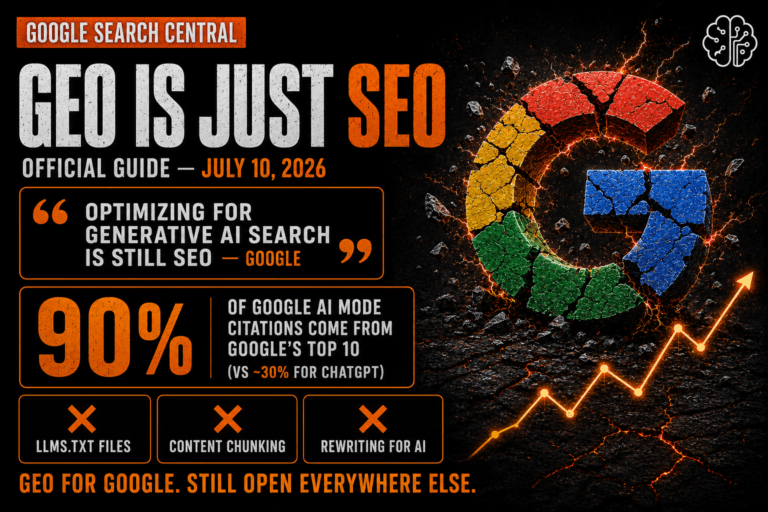
In late May 2026, two separate Google product teams gave conflicting guidance on llms.txt files. Google Search confirmed they provide no ranking or visibility benefit; a separate team suggested they may help AI agents access content more efficiently.
For now, the official Search position holds: llms.txt is unnecessary for Google Search visibility. If clients are being sold llms.txt optimisation as a GEO service, that’s a red flag worth flagging back.
The May Core Update Is Still Settling
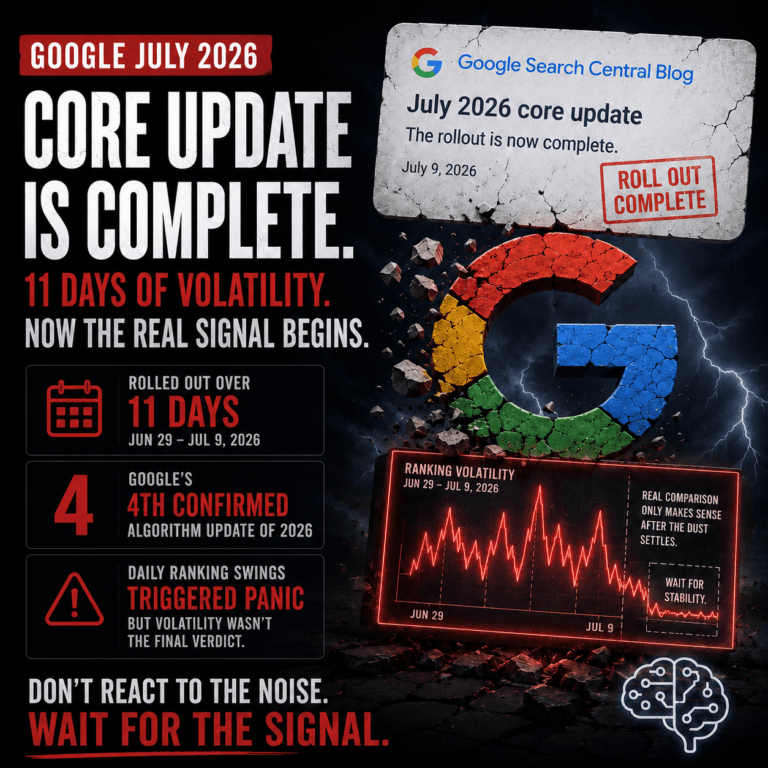
The May 2026 core update ran mid-rollout into early June. Ranking fluctuations during that window were expected and not a reliable signal of long-term impact. Google’s own guidance: wait at least one full week after a rollout completes before reviewing Search Console data or drawing conclusions.
If clients saw traffic shifts during that stretch, the right move was to hold steady and document the baseline, not make reactive content changes.
Build for the Full Picture
At Obsidian Pinnacle, we help businesses think about AI search as a complete system: technical foundations, citation-worthy content, and now the ad layer that’s moving into the same space. The brands that treat these as separate strategies will find themselves outpaced by the ones that don’t.
Ready to audit your full AI search presence? Book a consultation and let’s map out where you stand across every layer of Google’s evolving search landscape.
Related reading: In Google’s AI Mode, You’re Either Cited or You Don’t Exist · Google’s CEO Just Confirmed What Smart Businesses Already Know
Sources: Google Marketing Live 2026 recap (Search Engine Land), Search Engine Journal (May 2026)