On July 10, Google Search Central quietly published something the entire AI-visibility industry needed to read. It's an official guide on optimizing for generative AI search — and it takes direct aim at the terms "AEO" and "GEO." Google's position, in their own words: "From Google Search's perspective, optimizing for generative AI search is optimizing …

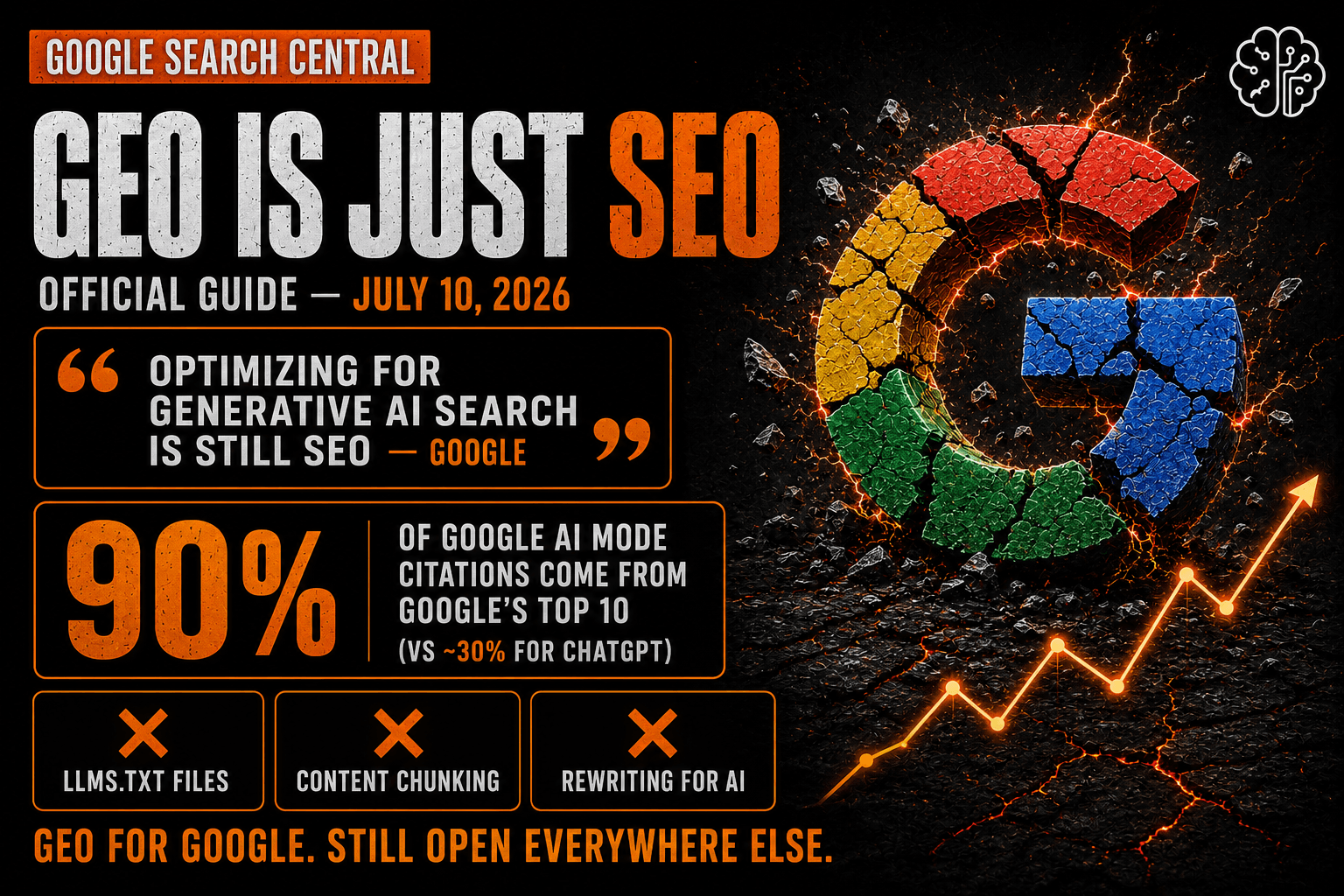
On July 10, Google Search Central quietly published something the entire AI-visibility industry needed to read. It’s an official guide on optimizing for generative AI search — and it takes direct aim at the terms “AEO” and “GEO.”
Google’s position, in their own words: “From Google Search’s perspective, optimizing for generative AI search is optimizing for the search experience, and thus still SEO.”
Translation: if you’re paying someone to do “GEO” for your Google visibility specifically, you may be paying twice for the same thing.
The Mythbusting Section Is the Real Story
Buried in the guide is a list of tactics an entire cottage industry has built pitch decks around. Google shot down each one, plainly.
LLMS.txt files? Google Search doesn’t use them. Creating one won’t help or hurt your visibility.
“Chunking” content into bite-sized AI-friendly pieces? Not a requirement. Google’s systems understand the nuance of a full page without you restructuring it for a machine.
Rewriting content in special phrasing just for AI systems? Unnecessary. Their models understand meaning and synonyms, not just exact keyword matches.
Chasing inauthentic mentions across the web to “train” AI on your brand? Doesn’t move the needle — the same spam and quality systems that govern regular Search results govern what shows up in AI Overviews and AI Mode.
Where Google Is Right
This isn’t Google being defensive. It’s structurally true. AI Overviews and AI Mode are built on retrieval-augmented generation — they pull from Google’s own Search index using Google’s existing ranking systems, then generate a response grounded in what they retrieve. If your page isn’t eligible to rank in regular Search, it isn’t eligible to show up in Google’s AI features either.
So for visibility inside Google’s own AI surfaces, the guide’s advice is simply good SEO: build valuable, non-commodity content with a genuine point of view, maintain clean technical structure, and monitor performance through the Generative AI performance report in Search Console. Nothing exotic.
Where the Advice Runs Out
Here’s the part the guide doesn’t — and can’t — address: it’s a guide to Google Search. It says nothing about ChatGPT, Perplexity, or Claude, because Google has no visibility into how those systems decide what to cite.
And that distinction matters more than it sounds. A recent benchmark from AI-visibility platform CiteLens found that Google’s own AI Mode and Perplexity draw roughly 90% of their citations from Google’s top 10 search results — no surprise, given how tightly grounded both are in traditional web indexes. ChatGPT pulled only about 30% of its citations from that same top 10.
That 60-point gap is the entire ballgame. It means ranking well on Google is a strong predictor of showing up in Google’s own AI answers, and a weak predictor of showing up in ChatGPT’s.
So What Should You Actually Do
Google’s guide is correct advice for one specific goal: visibility inside Google Search, AI Overviews, and AI Mode included. Follow it. It’s free, it’s official, and it will not steer you wrong.
But if your buyers are asking ChatGPT instead of Googling, that guide doesn’t cover you. Tracking your citation rate across each AI engine separately — not as one blended “AI visibility” number — is the only way to know whether you have a Google problem, a ChatGPT problem, or both.
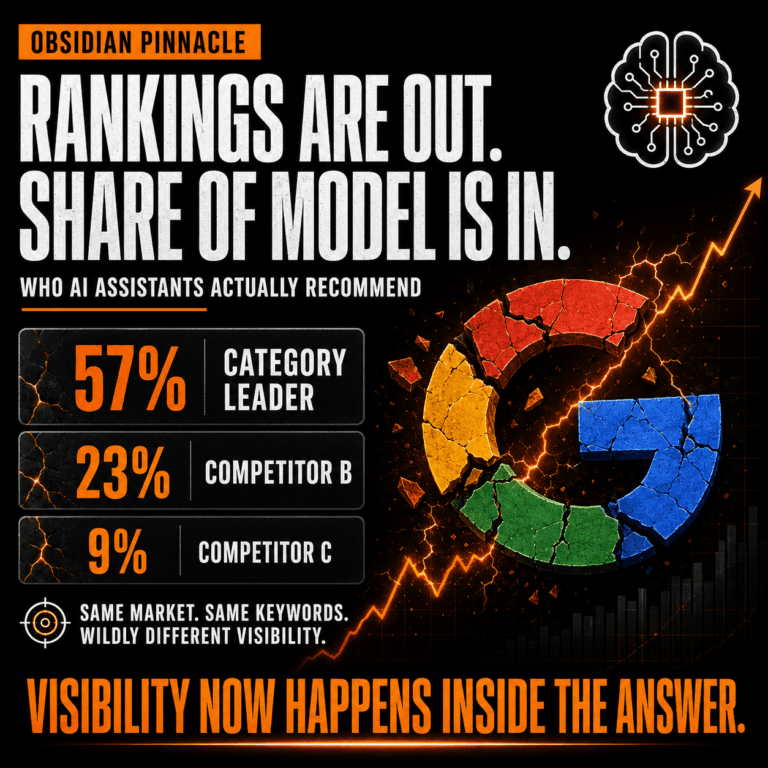
At Obsidian Pinnacle, we track share of model and citation sourcing across engines individually, because treating them as one metric hides exactly the gap that matters.
Not sure whether your visibility gap is a Google problem or an everywhere-else problem? Book a consultation and we’ll show you the breakdown.
Related reading: AI Visibility Is Measurable Now · Rankings Are Out. Share of Model Is In.
Sources: Google Search Central, “Optimizing your website for generative AI features on Google Search” (updated July 10, 2026); CiteLens AI-visibility benchmark, July 2026
Kevin